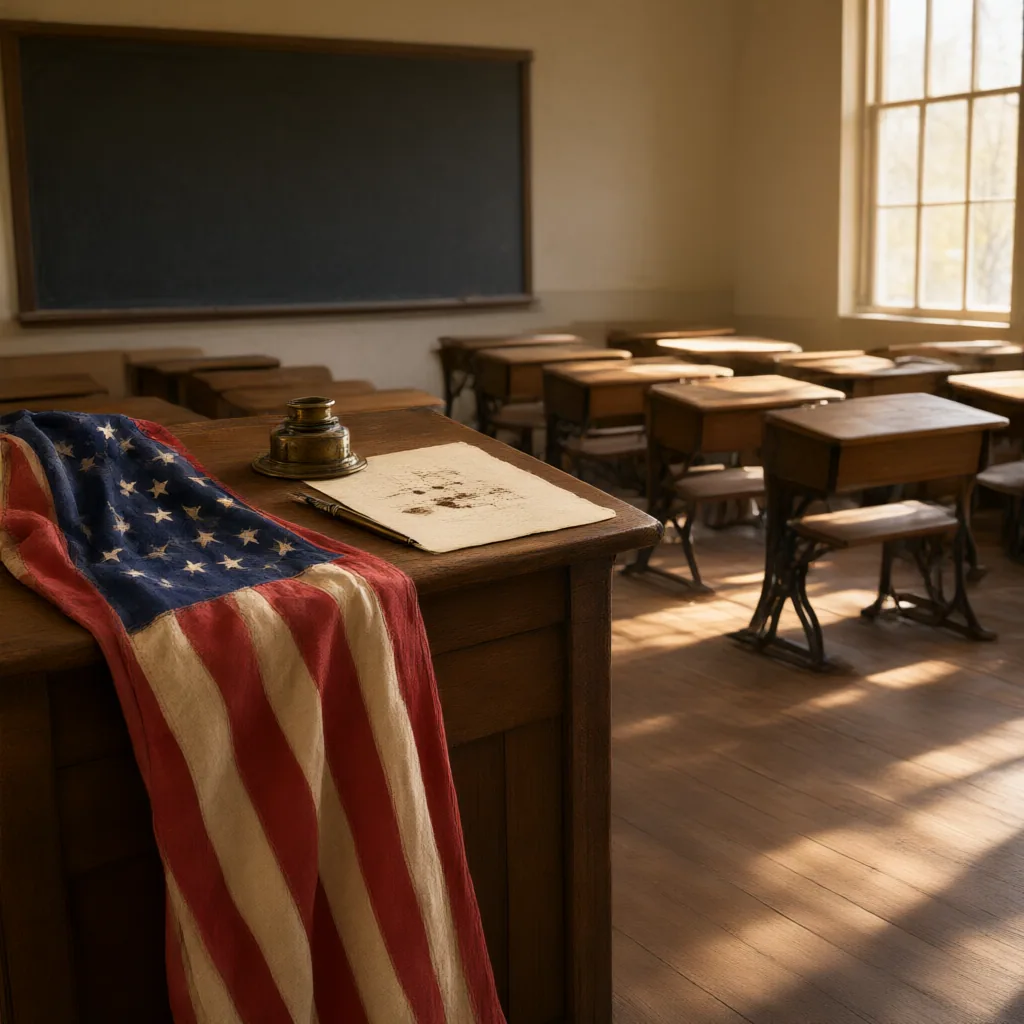
The Pledge of Allegiance emerged from a specific moment in late nineteenth-century American civic culture, when public ritual, mass education, and patriotic symbolism were being actively shaped for schools. Readers looking into its beginnings usually want more than the familiar recitation itself. They want to know who wrote it, why it was introduced, and how a short civic statement became a durable part of public life.
A school ceremony with a national audience
The Pledge was first published in 1892, a year marked by nationwide commemorations of the 400th anniversary of Columbus’s arrival in the Americas. At the time, schools were increasingly used to promote shared civic practices, especially for a country experiencing rapid growth, immigration, and regional change after the Civil War. Patriotic exercises fit that purpose: they offered a simple, repeatable way to express national belonging in classrooms across the country.
The wording that became the original Pledge was concise by design. It was meant to be spoken aloud by students, remembered easily, and attached to a flag-centered ceremony. That combination of brevity and ritual helped it spread quickly beyond the event that first popularized it.
Francis Bellamy and the magazine behind the campaign
The original text is most closely associated with Francis Bellamy, a Baptist minister and writer who worked with *The Youth’s Companion*, a widely circulated family magazine. Bellamy did not write in a vacuum. He was part of a broader publishing and educational effort that linked patriotic observance to school life.
That magazine had practical reasons to care about flag ceremonies. It promoted campaigns encouraging American schools to display the national flag, and those efforts gave publishers, educators, and civic organizers a strong incentive to package patriotism in forms that schools could adopt. In that context, the Pledge functioned as both an expression of civic ideals and a carefully framed school ritual. The origin story, then, is not only about a single author. It is also about institutions that understood how print culture, public ceremony, and classroom routine could reinforce one another.
Why the original language sounded the way it did
The first version began, “I pledge allegiance to my Flag and the Republic for which it stands, one nation indivisible, with liberty and justice for all.” Its phrasing reflects concerns that were especially meaningful in the late nineteenth century. The emphasis on the Republic, indivisibility, and liberty points to national unity as a central ideal, not just abstract patriotism.
That language also helps explain why the Pledge has remained historically important even as later generations debated or revised it. The original wording was shaped by the political and social priorities of its own era. Understanding those priorities makes the Pledge easier to read as a historical document rather than simply a familiar recitation.
From classroom exercise to enduring civic tradition
The Pledge did not become culturally significant overnight because of words alone. It gained force through repetition in schools, public ceremonies, and later civic life more broadly. Once tied to everyday practice, it became part of how many Americans learned national symbols and public language.
Its later history includes revisions, legal debate, and disagreement over interpretation, but those developments rest on the foundation laid in the 1890s. The origins matter because they show that the Pledge began as a constructed civic exercise with identifiable authors, promoters, and purposes. That makes it a revealing window into how American public traditions are made: not as timeless customs, but as responses to particular historical needs.
For readers studying civic language, school ritual, or the politics of national symbols, the early history of the Pledge offers a compact case study in how ideas move from print to ceremony and from ceremony into lasting public memory.