
U.S. naturalization ceremonies grew around a legally decisive oath, while group observances, civic addresses, patriotic symbols, and practical guidance developed to present citizenship as both a new legal status and a public commitment.
The Oath at the Center of the Ceremony
The Oath of Allegiance is the ceremony’s essential legal act: a person does not become a U.S. citizen until taking it. USCIS then presents a Certificate of Naturalization as official proof of citizenship. Other features—including music, flags, speeches, videos, and printed documents—give public meaning to that legal transition but are not equivalent to the oath.
The institution administering the oath depends on the ceremony. In a judicial ceremony, a court does so; in an administrative ceremony, USCIS does. USCIS guidance gives administrative ceremonies a standardized sequence that can include “Faces of America,” the national anthem, welcoming remarks, recognition of candidates’ countries, the oath, congratulatory remarks, the Pledge of Allegiance, concluding remarks, and certificate presentation. This structure joins a change in legal status to a visible affirmation of civic membership.

How Group Ceremonies and Civic Addresses Developed
According to the supplied secondary historical summary, immigrants were once commonly naturalized by federal judges during routine court proceedings. The Naturalization Act of 1906 helped encourage designated naturalization days, making group naturalizations more common. That development gave the legal proceeding a clearer public setting in which many new citizens could take the oath together.
The same summary identifies a 1940 congressional joint resolution as another influence on the modern ceremony. It asked judges to speak to new citizens about American government and the privileges and responsibilities of citizenship. Such addresses helped make civic instruction part of the occasion rather than treating naturalization only as a courtroom transaction.
These points explain broad institutional changes, but they do not establish when every song, symbol, or program feature first appeared. The supplied historical evidence should therefore be read as an account of the ceremony’s overall development, not a complete origin story for each tradition.
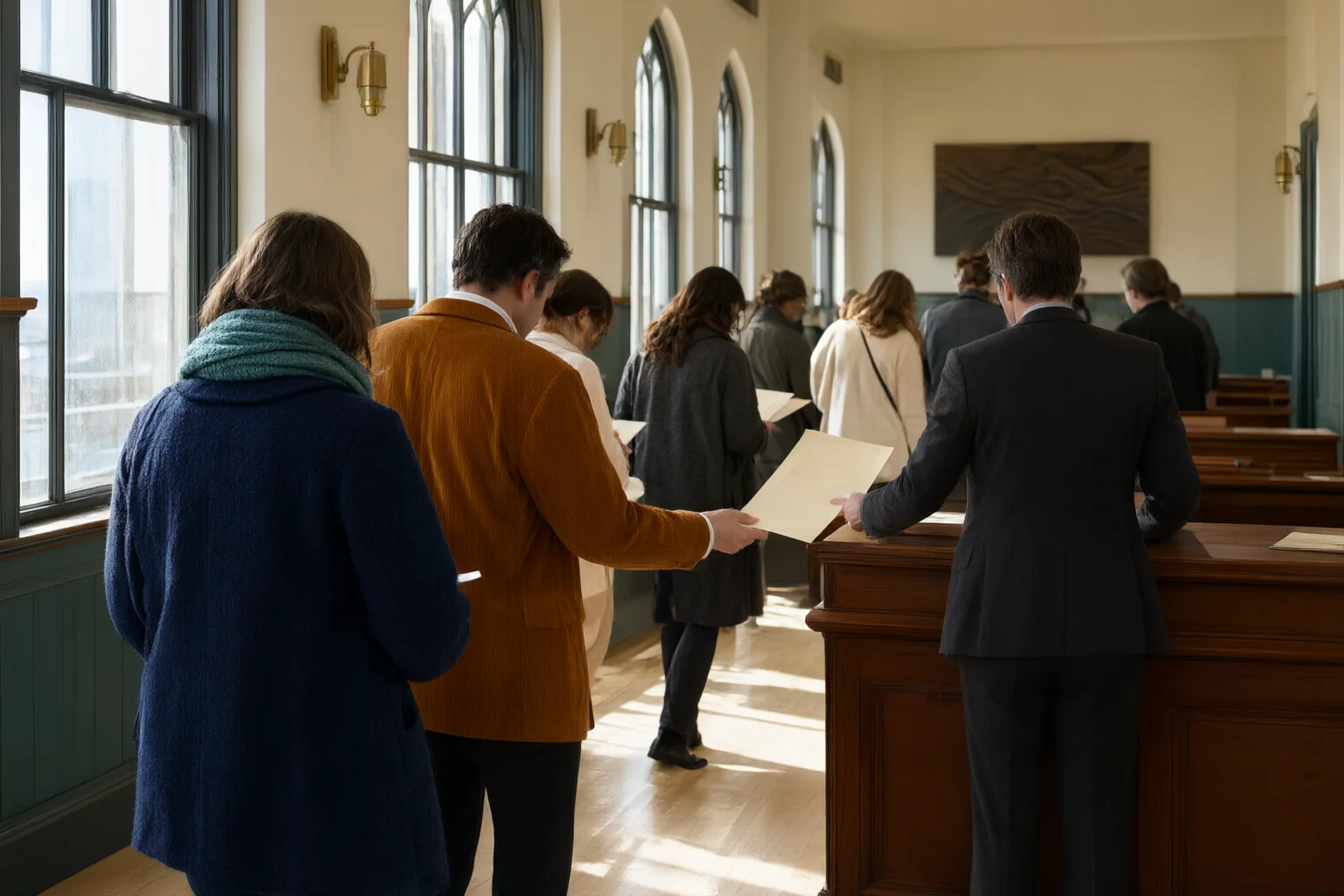
What Today’s Symbols and Community Roles Communicate
Present-day programs use shared words, objects, and settings to connect citizenship with national ideals and public belonging. USCIS describes songs, poems, and symbols as longstanding forms of civic expression; its materials include “The Star-Spangled Banner” and “America the Beautiful.” Administrative ceremonies may also make available an American flag, the Citizen’s Almanac, and pocket-size copies of the Declaration of Independence and Constitution, although the cited policy does not require distribution of those publications.
Courts hold public ceremonies in courthouses and community locations and describe them as opportunities to improve understanding of the judiciary. Schools can contribute a color guard, lead the pledge or a patriotic song, present flags, write welcome letters, or staff civic-information tables. Some ceremonies gain further symbolic weight from their setting or date, including observances at the National Archives on Constitution Day and Citizenship Day and ceremonies associated with Independence Day.
Programs can vary between judicial and administrative settings. The variation shows why a flag, song, or local contribution should not automatically be mistaken for a legal requirement.
Conclusion
Naturalization ceremonies combine four functions: the oath completes the legal transition, public ritual marks the occasion, civic instruction explains membership, and practical guidance helps new citizens act on their status. USCIS policy also protects the administrative ceremony from partisan, religious, commercial, promotional, and solicitation materials. Authorized voter-registration and other government materials may be offered after the ceremony, while USCIS points new citizens toward passport information and instructions for updating Social Security records.
To see these distinctions in practice, compare the program of a public naturalization ceremony with current USCIS guidance. Identify the legally decisive oath, note which features belong to a standardized program, and consider how optional music, symbols, speeches, and community participation convey civic meaning.
Disclosures and limitations
- This article was prepared with AI assistance from the supplied USCIS, federal-court, and secondary historical research sources. Historical claims are limited by the available secondary summary.
Related reading
Sources
- Naturalization ceremony – Wikipedia — en.wikipedia.org
- Naturalization Ceremonies | USCIS — USCIS
- Naturalization Ceremonies — United States Courts
- Chapter 5 – Administrative Naturalization Ceremonies — USCIS